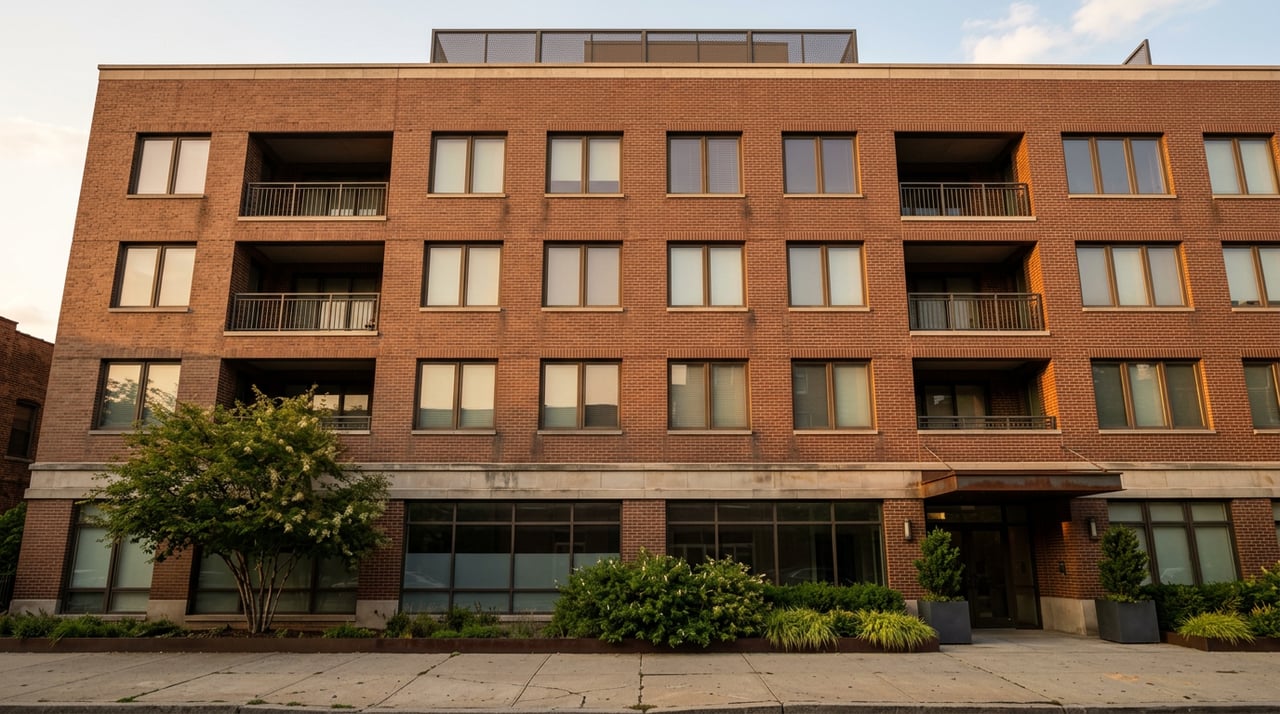
The Paperwork Timeline That Can Quietly Stall a Silver Spring Condo Closing
September 17, 2026
September 17, 2026
Two years ago, ordering a condo resale package in Silver Spring was a formality. You checked a box, paid a few hundred dollars, and moved on to inspections and appraisal. That is no longer true in the same way, and the reason has nothing to do with interest rates or inventory. It has to do with a Maryland law that changed on October 1, 2025, and with a document most sellers still treat as an afterthought.
If you own or are buying a unit in one of downtown Silver Spring's condo buildings, the Silverton at East-West Highway, MICA on Blair Mill Road, Metro 710, The Crescent on Wayne Avenue, or Solaire on Ripley Street, the resale package you receive or produce this year carries more weight than it did in 2023. The math behind the delivery deadline hasn't changed, but what's inside the package has.
Under Maryland's Condominium Act, a seller must give the buyer the association's governing documents (the declaration, amendments, bylaws, and rules) along with a Resale Disclosure Certificate, a document that lays out the building's financial and operational condition. The seller must deliver both at least 15 days before closing. Once the buyer has them in hand, they get 7 days to cancel the contract for any reason, no explanation required, deposit returned in full. Homeowners association sales work similarly under a separate statute, with a 5-day cancellation window instead of 7.
Here's where the timeline gets tight. The condominium association isn't required to hand over the certificate the moment someone asks. State law gives the council of unit owners up to 20 days after receiving a written request and the fee to prepare it. That 20-day allowance and the 15-day pre-closing delivery rule don't automatically fit inside a typical 30-day contract. If a seller waits even a week after ratification to request the package, and the association takes close to its full 20 days to produce it, the seller may already be past the point where they can deliver it 15 days ahead of the original closing date. The fix at that point isn't cancellation. It's an addendum pushing the settlement date, which is its own kind of leverage handed to whichever side wants it.
Sellers can compress the association's side of the clock. Maryland caps the standard preparation fee at $250, but allows optional rush fees, up to $50 for 14-day delivery or $100 for 7-day delivery, plus a modest inspection fee. Paying for the rush is often the cheapest insurance available in a transaction with a five-figure earnest money deposit on the line.
Maryland has required community associations to obtain a reserve study since 2022, under a law known as HB 107, passed in the wake of the Surfside condominium collapse in Florida. That law extended a reserve-study requirement that previously applied only in Montgomery and Prince George's Counties to the entire state. But the original version had a gap: associations had to study their future repair costs, they weren't required to actually fund them at the recommended level.
That gap closed on October 1, 2025, when amendments known as HB 292 and SB 63 took effect. Associations must now adopt a formal funding plan, developed with a reserve specialist using one of five recognized funding methods, and deposit the budgeted reserve contribution into the reserve account by the end of each fiscal year. Associations working through their first reserve study get a five-year window to ramp up to the recommended funding level, extended from the original three years. And critically, a board can now raise assessments to meet the reserve-funding requirement even where the building's own bylaws would otherwise cap the increase.
| Before October 1, 2025 | After October 1, 2025 | |
|---|---|---|
| Reserve study | Required, updated every 5 years | Still required |
| Funding to recommended level | Not mandated | Mandated, with formal funding plan |
| Bylaw caps on assessment increases | Generally enforceable | Can be overridden to fund reserves |
| First-time funding ramp-up | 3-year catch-up window | 5-year catch-up window |
| Board can defer funding | Not addressed | Allowed up to 2 fiscal years with a 2/3 vote and documented hardship |
This is not a story about any specific Silver Spring building being underfunded. It's a story about timing. Any association that is still in its first mandated funding plan, regardless of when the building itself was constructed, is now legally required to be climbing toward full reserve funding rather than deferring the decision indefinitely. A buyer reviewing a resale certificate today is more likely to see a documented funding ramp, a chosen funding method, or a hardship deviation than a buyer reviewing the same building's paperwork two years ago, simply because the law creating that paper trail didn't exist yet.
The resale certificate is not a formality to skim before signing. It's the closest thing a buyer gets to an association's financial statement, and in downtown Silver Spring's condo market it deserves the same scrutiny a buyer would give a home inspection report. Look for:
If you're listing a condo in Silver Spring this fall, order the resale package the day your contract is ratified, not after the home inspection contingency clears. Waiting even a few days narrows the margin between the association's 20-day allowance and the 15-day delivery deadline, and that margin is the difference between a routine closing and a settlement date renegotiated under pressure. If your building's management company is smaller or self-managed, which is common in some of Silver Spring's older properties, build in extra time. The law does not relax the deadline for buildings without a dedicated management office.
If you're buying, resist any pressure to shorten or waive the rescission window. It exists specifically so a buyer can walk away, deposit intact, after seeing the real financial picture rather than the marketing one.
Does this apply to townhomes with an HOA, not just condos? Yes, though the statute and the numbers differ. Homeowners association sales fall under a separate title of Maryland's Real Property Code, with a 5-day rescission window instead of the condo standard of 7. Some properties sit inside both a condo regime and a master HOA, which means two separate disclosure packages.
If I sell my condo "as-is," do I still need the resale package? Yes. The resale certificate and the state's property condition disclosure or disclaimer form are two separate legal obligations. Choosing the as-is disclaimer for your own known defects does nothing to exempt the association's required financial disclosures.
What if my building is self-managed with no property management company? The law applies the same way. A self-managed association still has 20 days to produce the certificate after a written request, and the seller still has to deliver it 15 days before closing. Self-managed buildings often move slower in practice, so request the package earlier than you think you need to.
Can the buyer's 7-day window and my 15-day delivery deadline just happen at the same time? They can, and in a well-timed transaction they should. As long as the certificate is delivered on or before the 15-day mark, the buyer's 7-day review period completes with time to spare before closing. The risk isn't the math of those two numbers together. It's what happens when the association's own turnaround eats into the calendar before the clock even starts.
Contract timelines like this one are exactly where a transaction can quietly go sideways, not because anyone did anything wrong, but because two separate statutory clocks weren't started early enough to fit. If you're buying or selling a condo in Silver Spring and want someone reading the resale certificate line by line before it becomes a problem, Paula Heard and The Heard YOU Team bring a contracts-attorney background to exactly this kind of detail. Schedule a free consultation to talk through your timeline before you're under contract, not after.
Stay up to date on the latest real estate trends.



I don’t just sell homes—I negotiate outcomes that benefit you. My background in corporate law gives me the edge to secure better terms and guide you through the process with total clarity and care.