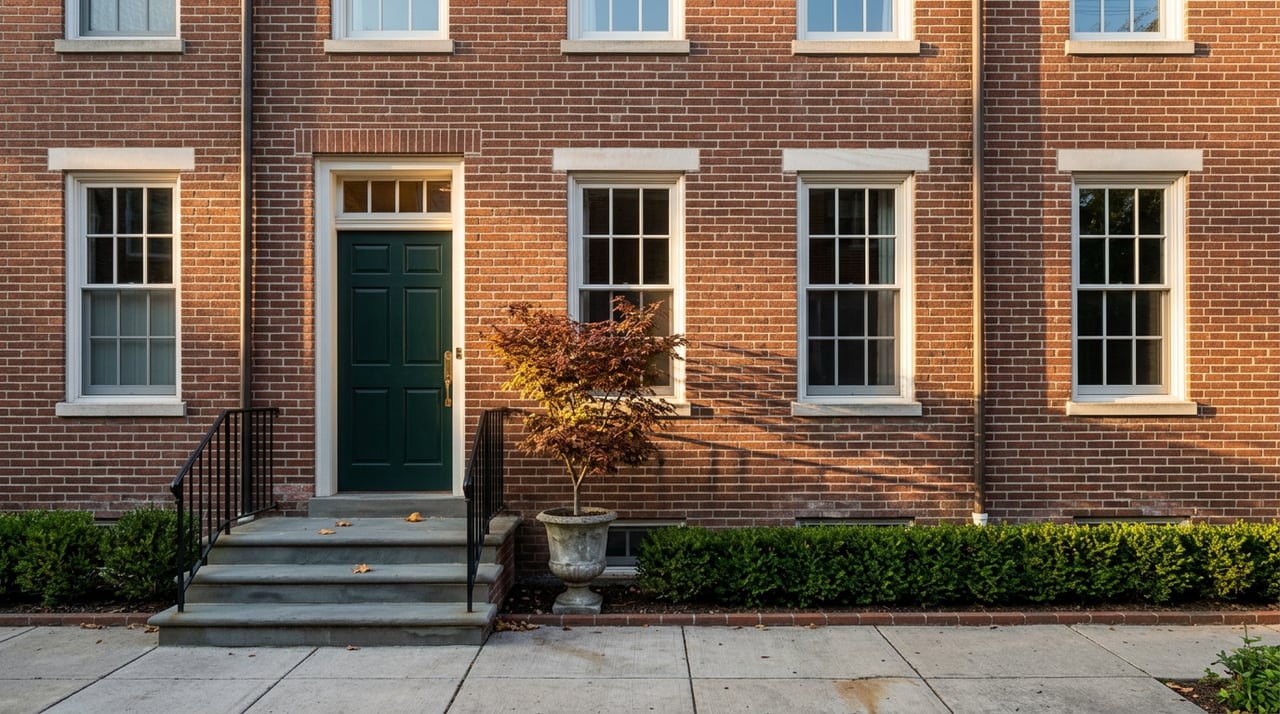
The Del Ray Premium: What Alexandria's Price Gap Is Actually Charging For
September 24, 2026
September 24, 2026
A buyer comparing two Alexandria listings last winter noticed something odd. The rowhouse in Old Town and the bungalow in Del Ray were priced within a few thousand dollars of each other. Same era, roughly. Same city services, same school system, same ten-minute drive to the Beltway. But only one of those two houses would require her to ask a city board's permission before she could replace a window.
That difference is one factor to consider when comparing Alexandria neighborhoods alongside median-price figures.
Ask most people which Alexandria neighborhood commands the steepest premium and they'll say Old Town. It has the cobblestones, the waterfront, the 18th-century pedigree. It's the neighborhood every guidebook photographs.
But in February 2026, Del Ray's median sale price came in at $831,500, up 7.3% year over year, against a citywide Alexandria median of roughly $630,000 for the same month. That's a 32% premium over the city as a whole. The price-per-square-foot gap tells the same story from a different angle: Del Ray sold at roughly $628 per square foot that month, about 33% above the citywide figure of $471.
Old Town is expensive too, no question. But the neighborhood most people assume carries the biggest markup isn't the one actually pulling the hardest away from the median. Del Ray is. The neighborhoods also differ in how exterior projects are reviewed.
Alexandria has seven National Register Historic Districts on the books, but only two of them are locally regulated. The city's Historic Preservation office confirms that Old and Historic Alexandria and Parker-Gray are the only districts locally regulated through the Board of Architectural Review, the seven-member body that must approve a Certificate of Appropriateness before an owner can touch anything visible from a public street or the river. New windows. A replaced door. An addition. Even painting masonry that's never been painted before.
Del Ray isn't inside either of those two districts. A renovation contractor working across the city puts it plainly on their own Alexandria service page: projects in Del Ray, Beverley Hills, and the West End move through standard residential permits with a typical three to six week review, while Old Town work runs through BAR first. The city's own preservation guidance backs that up. Outside the two locally regulated districts, exterior work is governed by ordinary building code, not a design board's judgment about historic appropriateness.
That's not a small distinction if you're the one holding the property.
Old Town's price tag buys genuine pedigree, and for plenty of buyers that's worth every dollar. It also means exterior changes visible to the public go through a review process. Minor projects can sometimes get an administrative sign-off from BAR staff in a matter of days. A denied application can't come back for another year.
One market analysis of Alexandria's mid-2026 conditions put the practical consequence directly: a rowhouse in the Old and Historic Alexandria District that needs exterior work carries embedded Board of Architectural Review timing risk, and that risk shows up in the appraisal and inspection cycle. It's not hypothetical. It's a line item buyers and sellers negotiate around.
Del Ray's premium buys a different bargain. You're still getting a neighborhood with real architectural identity, its craftsman bungalows date largely from the 1910s through the 1940s, and Mount Vernon Avenue's Main Street character is well documented in the city's own area planning materials. Del Ray is outside the two locally regulated districts, so exterior projects there do not go through BAR review.
Put those two facts next to each other and the comparison goes beyond price. Buyers can weigh architectural character and the applicable review process when evaluating a home.
The BAR distinction matters most for detached homes and rowhouses. But a meaningful share of both neighborhoods' inventory is condos, and there's a second friction point that surfaces the moment a buyer runs real numbers instead of comparing sticker prices.
Alexandria condo and HOA fees typically run between $400 and $1,200 a month, depending on the building's age and amenities. At the high end of that range, the fee alone can consume roughly $200,000 of a buyer's borrowing capacity under standard debt-to-income underwriting. A $500,000 condo carrying a $950 monthly fee, layered on top of Alexandria's fiscal year 2026 real estate tax rate of $1.135 per $100 of assessed value, can produce an all-in monthly cost that exceeds a $650,000 townhouse with no association at all.
That math changes who's actually competing for a given listing. A condo that looks like the more affordable option on a portal search can be the more expensive option once the fee and tax bill are added in, and the buyer pool for that unit is smaller than the sticker price suggests. These costs are useful to consider alongside a property's list price.
If you're deciding between an Old Town rowhouse and a Del Ray bungalow at similar price points, the smarter question isn't which neighborhood is "worth more." It's which regulatory environment fits the renovation you're actually planning to do.
If the house you're buying is close to move-in ready and you don't expect to touch the exterior for years, BAR review may be less central to your plans. If you're buying with a kitchen bump-out or a rear addition already in mind, that timeline belongs in your offer strategy and your closing date, not something you discover after ratification. A Certificate of Appropriateness process can affect a renovation timeline, so it is worth considering when planning an offer and closing date.
For condo buyers in either neighborhood, ask for the current reserve study and the full fee schedule before you fall in love with a unit. The fee is the number that decides whether the deal actually works, not the list price.
Does the Board of Architectural Review control interior renovations too? No. BAR jurisdiction covers exterior alterations, new construction, and demolition that's visible from a public street, alley, or the Potomac. Interior work like cabinets, flooring, and countertops generally doesn't require BAR approval, though it still has to meet standard building, electrical, and plumbing code.
Is Del Ray one of Alexandria's regulated historic districts? No. The city's only two locally regulated historic districts, the ones that trigger Board of Architectural Review authority, are Old and Historic Alexandria and Parker-Gray. Del Ray sits outside both, which is why exterior renovation work there runs through standard city permitting rather than a design-review hearing.
How fast is a BAR approval, realistically? It depends on the scope. Minor administrative approvals can be turned around by preservation staff in a matter of days. Projects requiring full board review go to a public hearing, and if the board denies an application, that same case can't be resubmitted for a year.
Comparing two neighborhoods involves more than price; permit applications, renovation timelines, and association fees can also affect the decision. If you're weighing Old Town against Del Ray, or considering the costs and review processes associated with a listing, Paula Heard brings a contracts attorney's read to every offer before you sign one. Schedule a Free Consultation to talk through what your budget actually buys in either neighborhood.
This article is general information, not legal, tax or financial advice. Consult a qualified professional about your situation.
Stay up to date on the latest real estate trends.
I don’t just sell homes—I negotiate outcomes that benefit you. My background in corporate law gives me the edge to secure better terms and guide you through the process with total clarity and care.