North vs South Arlington: Housing, Transit, And Lifestyles
June 4, 2026
June 4, 2026
Trying to choose between North and South Arlington? You are not alone. Many buyers and movers narrow their search to Arlington, then realize the bigger question is which part of Arlington fits their home style, commute, and day-to-day routine. This guide breaks down how North and South Arlington differ in housing, transit, and lifestyle so you can compare your options with more confidence. Let’s dive in.
In practical terms, Arlington County generally uses Arlington Boulevard, or Route 50, as the rough divider between North and South Arlington. At the same time, the County makes clear that this is more of a helpful shorthand than a strict planning boundary.
That matters because Arlington is organized around major transportation corridors as much as it is around neighborhood identity. For buyers, the most useful comparison is often this: North Arlington is closely tied to the Rosslyn-Ballston corridor, while South Arlington is often discussed through Columbia Pike, Crystal City, Pentagon City, and Shirlington.
Before comparing North and South, it helps to understand Arlington as a whole. Arlington is a strongly multifamily market, with 71.3% of housing units classified as multifamily, 22.9% as single-family detached, and 5.8% as single-family attached.
The County profile also reports a 41.3% owner-occupied rate, a median owner-occupied home value of $895,000, and a median gross rent of $2,322. Since 2020, 99% of Arlington’s net housing growth has come from multifamily apartments and condos.
If you are starting your search here, that means condos, apartments, and attached housing will shape a big part of the inventory you see, no matter which side of Arlington you prefer. The difference is often how that housing is distributed and what surrounds it.
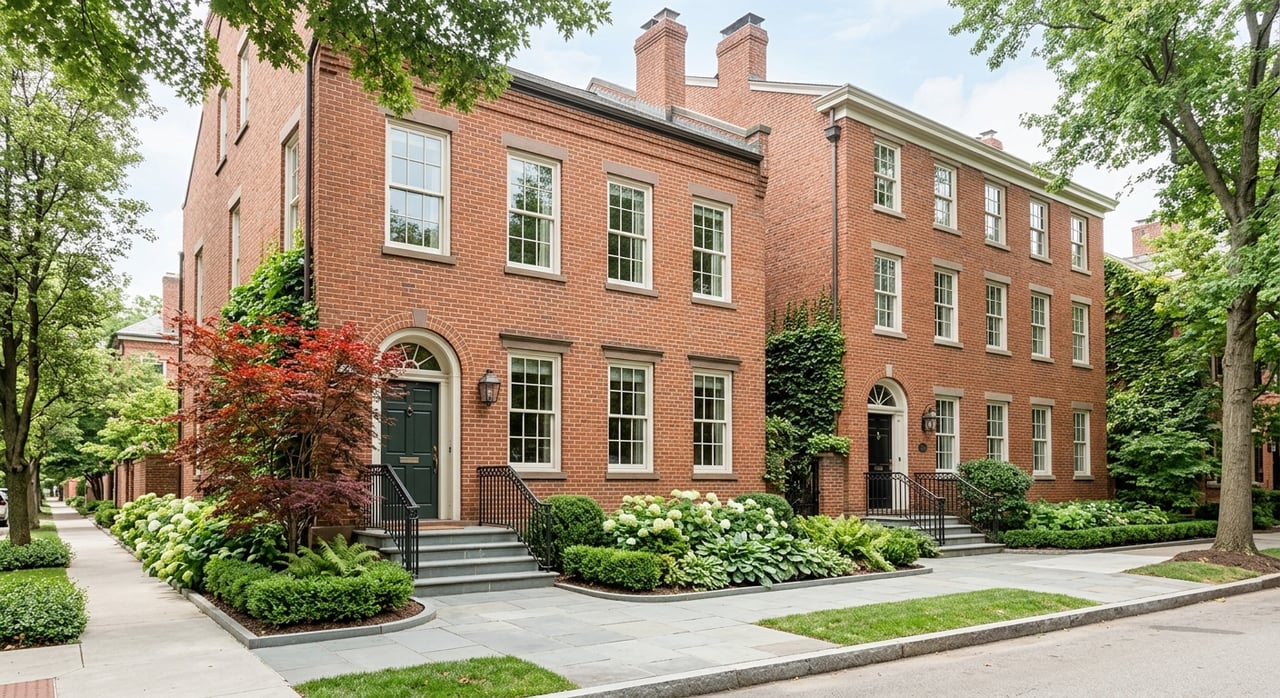
North Arlington usually offers the broadest mix of dense urban housing and more traditional residential streets. In and around the Rosslyn-Ballston corridor, you will find high-rise condos and apartments, mid-rise buildings, townhomes, and some duplex or semi-detached housing.
Rosslyn is one of the clearest examples of this mix. The area includes high-rise apartments and condos, older smaller buildings, and newer luxury townhouses, giving buyers several ways to balance walkability, building style, and price point.
Ballston also brings variety. The housing stock includes townhomes, duplexes, and semi-detached dwellings, all within a major transportation and activity hub.
If you want a more traditional residential feel, North Arlington also has established neighborhoods with more detached homes. Cherrydale is primarily single-family, with 829 single-family homes among 887 properties, while Westover is known for its surrounding single-family homes alongside nearly 700 garden apartments built in the 1940s.
For many buyers, North Arlington feels like a blend of urban convenience and established neighborhood texture. You can be close to Metro, restaurants, and retail while still finding pockets with quieter residential streets and a less vertical feel.
That does not mean every part of North Arlington feels the same. Rosslyn, Clarendon, Ballston, Cherrydale, and Westover each offer a different rhythm, but the broader pattern is consistent: more rail-centered density near stations, with lower-density neighborhoods around it.
South Arlington is also mixed, but the pattern tends to be more corridor-based. Instead of one dominant rail corridor like Rosslyn-Ballston, South Arlington often feels like a collection of connected districts with different housing types and commercial centers.
Shirlington includes townhouse communities, high-rise apartments, and other residential options. Pentagon City also offers varied housing types integrated with major commercial buildings, while Crystal City is planned as an increasingly walkable, transit-oriented district with 7,600 net new housing units over the life of its sector plan.
Along Columbia Pike, Arlington County has used housing and zoning tools to preserve and add affordable housing. Since the 2012 area plan, the County reports 626 committed affordable units added there, and the corridor also includes Barcroft Apartments, a 1,335-unit garden apartment community.
Green Valley adds another layer to South Arlington’s housing picture. It combines historic character with mixed-use, pedestrian-friendly commercial space along Shirlington Road.
South Arlington often appeals to buyers who want a more varied, corridor-driven mix of housing, retail, and transit choices. One area may feel centered on shopping and rail, while another is shaped more by bus service, trails, mixed-use streets, or garden apartments.
That block-by-block variation can be useful if you want options. It also means your best-fit location may depend less on a broad label like “South Arlington” and more on whether you are drawn to Pentagon City, Crystal City, Columbia Pike, Shirlington, or Green Valley.
If your top priority is rail access, North Arlington is usually the strongest starting point. It is Arlington’s most rail-dense area, anchored by the Rosslyn-Ballston corridor.
Rosslyn is the first Virginia stop for Orange, Silver, and Blue line trains. Clarendon, Virginia Square-GMU, and Ballston-MU are Orange and Silver line stations, and Arlington County notes that high-density development in the corridor is generally concentrated within a quarter-mile of each station entrance.
For many commuters, that translates into a simple daily routine. You may be able to walk to rail, live near dense station-area services, and rely less on transfers or driving for your regular commute.
South Arlington still offers strong transit, but the mix is different. Rail access is concentrated at Pentagon City and Crystal City, both served by the Blue and Yellow lines.
Pentagon City also has a direct connection to the Fashion Centre, while Crystal City connects to Metroway and sits close to VRE service at Crystal City Station, which serves both the Fredericksburg and Manassas lines. That makes South Arlington especially relevant if your routine depends on more than just Metro.
Shirlington helps connect the broader area through bus service from Shirlington Bus Station and trail access toward Crystal City, the Pentagon, and Washington National Airport. Arlington County’s transit system also includes ART, which operates 16 routes and supplements Metrobus with neighborhood connections to Metrorail and VRE.
If you want the most rail-dense setup and the easiest path to an urban, station-area lifestyle, North Arlington often comes out ahead. If you want Blue or Yellow line access plus stronger connections to bus service, commuter rail, major retail, and major employment centers, South Arlington may be the better fit.
The key is not asking which side is better in the abstract. It is asking which transit pattern matches how you actually move through your week.
North Arlington’s lifestyle is often built around walkable neighborhood nodes and established residential streets. Clarendon is known for shops, bars, restaurants, public art, open space, and tree-lined streets.
Ballston combines office and residential buildings with hotels, shops, restaurants, open spaces, and major transportation access. Rosslyn offers a more high-rise urban setting with office towers, condos, parks, and restaurants.
Beyond the most urban pockets, North Arlington also includes residential areas with access to parks and nature-focused amenities. The County highlights neighborhoods north of Langston Boulevard for their residential character, parks, Gulf Branch Nature Center, and Potomac Overlook Regional Park.
South Arlington’s lifestyle is more corridor-oriented and mixed-use. Columbia Pike is described by Arlington County as Arlington’s Main Street, with housing, local shops, and culturally diverse restaurants.
Shirlington stands out as Arlington’s arts-and-entertainment hub. It includes Signature Theatre, cafes, restaurants, shops, parks, a dog park, a cinema, and the public library.
Pentagon City is a major dining and shopping destination, while Crystal City offers Restaurant Row, underground shops, and convenient access near the airport. Green Valley’s Nauck Village Center adds a pedestrian-friendly mixed-use atmosphere along Shirlington Road.
The best choice depends on what you want your daily life to look like. If you picture a shorter walk to Metro, a stronger condo or townhome environment, and dense station-area living, North Arlington may deserve first priority.
If you want a mix of Blue and Yellow line access, VRE connections, larger retail centers, arts and entertainment options, and corridor-based neighborhood variety, South Arlington may fit better. If detached homes or quieter residential streets matter most, it can be smart to compare specific pockets on both sides rather than relying on a simple north-versus-south label.
A focused home search can save you time, stress, and second-guessing. When you know your commute pattern, preferred home type, and lifestyle priorities, it becomes much easier to narrow Arlington into the places that truly match your needs.
If you are weighing North Arlington against South Arlington, the right guidance can help you compare tradeoffs clearly, protect your interests, and move forward with confidence. Paula Heard brings a practical, detail-driven approach to Arlington home searches, with the high-touch support and contract guidance that can make a fast-moving decision feel much more manageable.
Stay up to date on the latest real estate trends.
I don’t just sell homes—I negotiate outcomes that benefit you. My background in corporate law gives me the edge to secure better terms and guide you through the process with total clarity and care.